
By Admin
13 October, 2025
Gastrointestinal (GI) perforation is a severe medical condition that happens when a hole starts to form in the walls of the digestive tract, leading to leakage of intestinal contents into the abdominal cavity. This condition can be life-threatening, requiring immediate surgical intervention to repair the perforation and prevent complications such as peritonitis or sepsis.
Traditionally, open surgery has been the go-to method for addressing GI perforations, but with advances in medical technology, minimally invasive surgery (MIS) has emerged as a suitable alternative. Here, we will explore the differences between minimally invasive and traditional GI perforation surgery and how they impact patient outcomes.
Open surgery has been the standard treatment for GI perforations for decades. This procedure involves making a large abdominal incision to get full access to the affected area. The surgeon repairs the perforation, cleans the abdominal cavity, and addresses any complications, like infection or damage to nearby tissues.
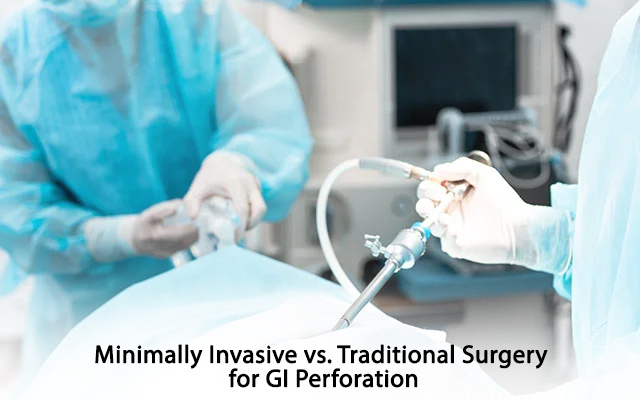
Minimally invasive surgery, commonly performed via laparoscopy, uses small incisions and specialized instruments to repair the perforation. A laparoscope is inserted through one of the small incisions, providing the surgeon with a magnified view of the abdominal cavity on a screen. The surgeon then uses the other surgical instruments to close the perforation and clean the area.
Several studies have depicted that minimally invasive surgery can result in better outcomes for patients in terms of shorter hospital stays, faster recovery, and reduced postoperative pain. However, the decision to perform MIS versus traditional surgery depends on the specifics of the perforation, the patient’s health, and the resource availability.
In circumstances where immediate and comprehensive access is required, traditional surgery might still be the most preferred option. On the other hand, for smaller perforations, minimally invasive surgery serves as a less traumatic alternative.
To know the most suitable treatment for your condition, reach out to the GI doctors at the best gastroenterology hospital in Dum Dum.
With advancements in laparoscopic techniques, MIS is becoming a preferred option for its advantages in reducing recovery time and postoperative complications. However, traditional GI perforation surgery remains an essential approach for more complex cases.

Why Is Geriatric Medicine Vital for Holistic Senior Health?
14 February, 2026

What to Expect Before and After Cancer Surgery?
8 October, 2025

What is the Significance of Cancer Staging?
8 October, 2025